
Summer 2023
PMH STORY
Ten years ago he was a new patient. In his early 80s, he looked stronger than usual. But as I listened to his lungs on the first visit, there was a problem. A chest x-ray showed a chronic disorder called bronchiectasis, with risk for serious pulmonary complications, respiratory failure, and reduced life expectancy.
The first few months, we used antibiotics to get the chronic infection under better control and started breathing treatments. He was great for this. But I saw multiple other areas where he was not following recommendations, and in our meetings, he was willing to accept some advice, but was relatively strict in rejecting other advice, like getting consultations. His daughter was a physician. I asked her about her father’s strong mindedness, and she said she had no idea what to do about it, as he had always been that way.
As years passed, illness at times raised the question of hospitalization, consultation, and more complicated treatment. Repeatedly, he declined care at the hospital or in the emergency room and insisted on care at home. I spoke to the physician daughter, and she said she understood and that there was nothing she could do. I learned that this man’s decisions were working out for him. Though he had serious lung disease, he was at home, and made his own decisions.
This spring, he had another episode of pneumonia. The vital signs, laboratories and exam all indicated the need for hospitalization. I drove him to the emergency room, where x-rays and laboratories confirmed a serious pneumonia. But then he left the hospital against medical advice. I spoke to him before he left the emergency room. He made clear his preference, and I provided antibiotics to support him in his choice for care at home. He got better. Several months later, he is back to baseline and in good Spirits.
Doctors learn from their patients and choices. Occasionally, there are times when perhaps there is only one right way, but many medical decisions are best guided by the doctor and the patient working together honoring the patient’s goals and choices. In my prior practice experience, it would have been very hard to care for this self-directed, hospital avoidant gentleman. PMH gives the patient and doctor time to understand each other, make mutual decisions, and have plenty of time to respect the patient’s Choices.
PMH allows doctors, patients, and families to understand each other’s choices and wishes better. That is good for the patient, the doctor, and the family.
Allan R. Kelly, MD FACP
ADDING SALT AT THE TABLE
It is generally accepted that the Western diet is too high in sodium. A study in England using the computerized health records of 500,000 UK citizens looked at the impact of adding salt to food at the table. Using salt while cooking was not a factor, but just the response to one question “Do you add salt to your foods?” The answers could be no, usually, or always. Those who always added salt to their food showed the average life expectancy for women was 1.5 years lower and life expectancy for men was 2.3 years lower. Amongst the obese subjects, the relationship was less clear.
There may be other reasons for the results. For example, people who always add salt may be accustomed to a saltier diet or more snack foods. The conclusion remains: people who “always” added salt to their food had decreased survival and probably decreased quality of life.
Robert H. Kelly, MD FACP
DEMENTIA, HEALTH, & COMMON SENSE
Bruce Miller, M.D, a neurologist at University of California, San Francisco School of Medicine lectured on “dementia and primary care.” Dr. Miller introduced his colleague, Stanley Prusiner, M.D., a Nobel Prize laureate, and neurologist. They discussed modifiable risk factors for dementia. Dr. Miller discussed that alcohol consumption is a risk factor for Alzheimer’s disease and dementias, even one drink a week. Other top factors included head injury (falls), pollution, low education, hypertension, smoking, hearing impairment, obesity, depression, sleep, and physical activity. “Protective” exercise was defined as 45 minutes a week. Exercise correlates with brain connectivity and reduces inflammatory biomarkers and impaired function. Dr. Miller also discussed how “intuitively” he did not feel right if he did not get exercise.
Another recent report looked at tobacco use and dementia. The incidence of dementia was based on cognitive testing in 1996-1998 with retesting in 2011-2013. Risk of dementia was 33% higher amongst current tobacco users compared to those who never used tobacco. Those who quit in the interval between the two evaluations had a 25% increased risk of dementia compared to those who never used tobacco. The conclusion was that as the time since quitting tobacco use increased, the risk of dementia decreased. It is never too late to quit using tobacco.
If good health is the goal, whether using intuition, common sense, the recommendations of a royal commission, or the advice of a distinguished professor of Neurology at the University of California, there are things we can do that yield better health: use no tobacco or alcohol, avoid sugar, reduce falls/head injuries, get more exercise, sleep, and education. It is common sense and scientifically valid that we injure our brain with substances, pollution, injury, and ignorance.
Robert H. Kelly, MD FACP
DIABETIC PERIPHERAL NEUROPATHY
A study of 68 persons with diabetic peripheral neuropathy (DPN) was published in 2021. Standard treatment for peripheral neuropathy included gabapentin, Lyrica or amitriptyline. In a randomized blinded fashion, one-half of the group were treated with vitamin D 5000 units daily and the other half were treated with a placebo pill. Neither group knew what the pill was, nor was supposed to be, other than it was a treatment for neuropathy pain. Satisfaction with treatment was then measured eight weeks later. The differences were significant and noticeable to patients. With regard to measuring the mood of patients, there was an improvement in mood in 88% of the patients given vitamin D, and 70% of the placebo patients. Pain was improved by 1 point on a 100- point analog scale, not clinically meaningful. There are many reasons to consider a vitamin D supplement. Helping people feel better is a good one.
Robert H. Kelly, MD FACP
SUGARY DRINKS…AND DEATH
There has been concern that sugar use is not good for us. There have been very few randomized control trials, to prove causation, but many observational studies showing Association.
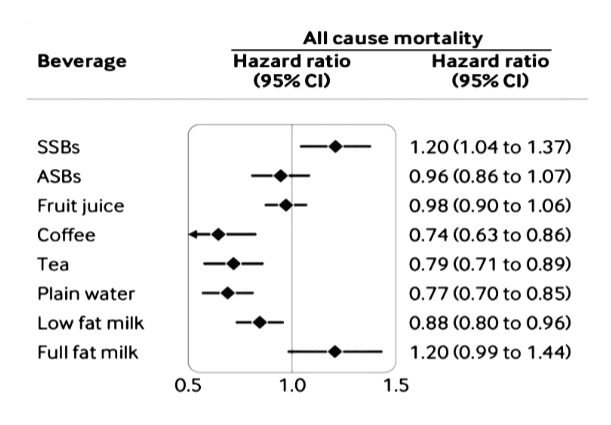
An important example of this observational research was published in the British Medical Journal in April 2023 based on the nurses’ health study which began in 1976. The study enrolled 122,000 female registered nurses aged 30 to 55. It was supplemented in 1986, including 52,000 male health professionals, largely physicians. In the study, participants with a new diagnosis of diabetes were selected. Researchers looked at how the use of sugar beverages changed after the diagnosis of diabetes. Many different beverage types were studied: Sugar-sweetened beverages, artificially sweetened beverages, fruit juice, coffee, tea, low-fat milk, full-fat milk, plain water, caffeinated, caffeine free, carbonated, and noncarbonated. To avoid confounding, scores of other variables were also studied.
The results were specific and notable. The use of sugar-sweetened beverages after the diagnosis of diabetes increased mortality significantly. The increase in the use of coffee, tea, and plain water as well as low-fat milk products benefited mortality. Increasing the use of coffee, tea, and plain water after the diagnosis decreased the risk of death. The magnitude of risk was a 20% increase in the risk of death by increasing sugar-sweetened beverages by one beverage per day on average. Increasing the use of coffee, tea, or plain water reduced the risk of death by a factor of 20 to 30%. The table shows all-cause mortality data from this experiment. It is a reminder to reduce the use of sugar-sweetened beverages (SSB) and artificially sweetened beverages (ASB). It is a reminder that coffee, tea, and plain water are probably good for you, compared to other beverages. And it is also a demonstration of endurance and good research: The nurses’ health study has been with us for 45 years, and we continue to learn from it. Bravo to whoever initiated the nurses’ health study so many years ago.
Allan R. Kelly, MD FACP
SURGE IN CASES OF SYPHILIS
JAMA reports that syphilis cases surged in the United States from 2019 to 2021, increasing 32%. Also, the editors note the increasing numbers of hepatitis B and hepatitis C infections in an era when treatment is available, and vaccines are widely administered to younger people.
Vaccines and treatments save lives. But we also know that certain behaviors increase the risk of infection and death: Age of onset of sexual activity, promiscuity, drug use, especially intravenously, alcoholism, and cigarette use are examples.
Authors from Harvard and the Coalition for Global Hepatitis elimination, opined as follows: “The plan developed by representatives from across the Department of Health and Human Services with input from multiple external partners, recommend 55 major strategies and some 150 specific government wide actions to prevent new infections and improve early diagnosis and treatment of viral hepatitis.”
The authors state that the incidence of hepatitis infections has doubled since 2013 despite the availability of curative medical treatment.
Nowhere in the articles is there any mention of the risk factors that so markedly increase disease transmission: Promiscuity, sex with high-risk partners, and the use of drugs and alcohol.
As a physician, I want my patients to know that there are many simple things they can do to promote their health and well-being. Whether or not, the 150 specific government actions or the 55 major government strategies can improve the health of these brothers and sisters, I am unsure.
Allan R. Kelly, MD FACP
QUOTES
“To the insulin committee of Toronto, and through its recommendation to the Eli Lilly Company, I have been indebted for the rare privilege of using insulin. For this, I cannot be grateful enough.”
Elliot P. Joslin, M.D., 1923.
“If we are not careful, we might even convince society that the electronic medical record, and what it represents, is an end in itself, it is more important than taking care of the sick, training our successors, and finding cures for human disease. Or is it already too late? Do you read me, HAL?” Instead of supporting clinicians seeking to deliver care more effectively and efficiently, current EHR [Electronic Health Record] design and configurations, attempt to manage clinicians and how they do their work. The deterioration in the patient-clinician relationship and increased clinical burden are often blamed on the EHR.
Don Dentmer, M.D. 2023 JAMA