
Spring 2018
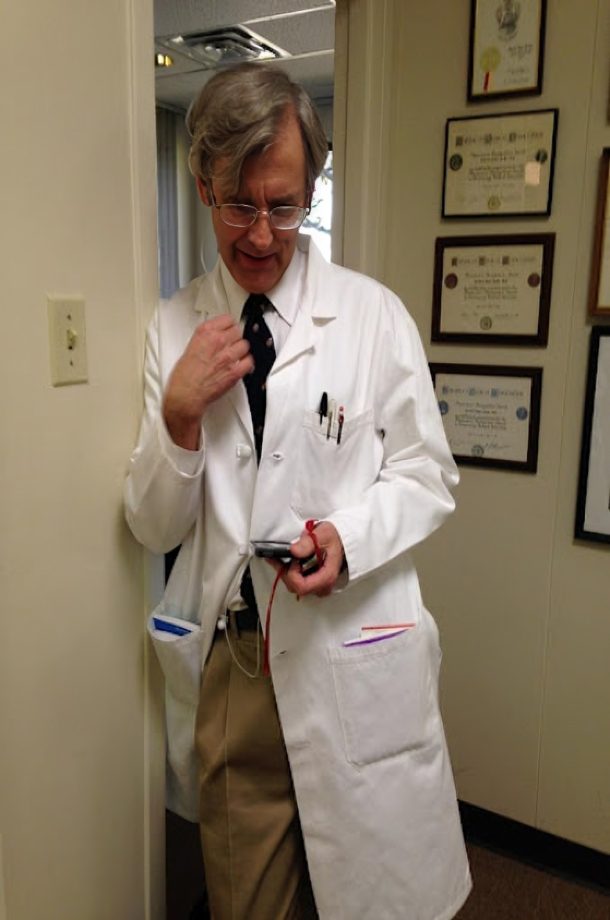
PMH STORY
Continuity of care is one component of good care. We try to use our records, but there is much in life that is not written down or indexed. How much paper and how many computer screens can we look through in trying to make a good decision? But there is also human memory, the knowledge that comes from being with someone, working with them, and getting to know them.
The PMH doctor admitted the patient to the intensive care unit. She had fallen down the stairs, and we suspected that she had struck her head and suffered brain injury. She was unconscious, on life support, unable to breathe or protect her airway, and comatose.
The next morning there was no improvement. Multiple calls were made to the doctor by the Ethics Committee and other members of the team at the hospital. The suggestion was to stop life support. As it happened, Dr. Gordon Kelly was retired but in the office having a cup of coffee. He had known this patient for decades. The PMH doctor asked Dr. Kelly if he would like to make rounds. He said yes.
We went up to the intensive care unit. There was a crowd outside the door and inside the room: the pulmonary specialist, the neurologist, the nursing team, and family. The nurses and neurologist went through a detailed presentation of what had been happening since the patient was found on the stairs. The prognosis was grim. The assembled professionals thought that the ventilator should be stopped and care withdrawn. At this point, Dr. Gordon Kelly made the following comment: This is exactly what happened to her after her aneurysm surgery in 1990 resulted in a series of seizures.
We had no paper or computer records from 1990. The family could not remember what had happened in 1990. With Dr. Kelly’s recollection of those events, we concluded that a possible diagnosis was seizure with postictal coma. We decided to continue supporting the patient. Over the next three days, the woman regained consciousness, was able to be taken off the ventilator, and she lived happily with her family at home for another 7 years, up on her feet and back to life.
This is a story of continuity that changed the minds of everyone in the room, and it changed the life of a family. Continuity in smaller doses and less dramatic fashion is helpful to nurses, doctors, patients, and families.
Allan R. Kelly, MD, FACP
TEA CAN ALSO BE A FRIEND
Tea is the most widely consumed beverage worldwide. Where more tea is consumed, there is less heart disease, perhaps because tea replaces soft drinks or alcohol, but it may be because there is something good about the tea itself.
Robert H. Kelly, MD FACP
NARCOTICS FOR PAIN
New research continues exploring narcotic therapy for pain. Narcotics as opium have been available to humans for thousands of years. Opium consists of equal amounts of codeine and morphine. It is easily available throughout the world.
Allan R. Kelly, MD, FACP
Robert H. Kelly, MD, FACP
TOO MUCH INFORMATION
For patients with non-insulin-treated diabetes, there may be no benefit to home testing of blood sugar. The dogma is that diabetics should do self-monitoring, “an important complement” to measurement of A1C. But finger stick glucose monitoring imposes cost and inconvenience on the diabetic. Researchers sought to prove that self-monitoring makes a difference.
Robert H. Kelly, MD FACP
SHINGLES VACCINATION
There is a new shingles vaccine that the Centers for Disease Control recommends for everyone over 50.
Allan R. Kelly, MD, FACP
CHRONIC BACK PAIN
In Portugal, 97 patients with low back pain were randomized. Half got a placebo and were told the pill was a placebo. Half got no pill at all.
Robert H. Kelly, MD FACP
PMH QUOTATIONS
“The landscape in which medicine is practiced today presents a moral hazard for most practitioners. The rules are set in the boardrooms, the paycheck guaranteed and the creative tension at the bedside vanquished. The result is a joyless practice of medicine devoid of medicines’ artistry and burgeoning with frustrated physicians…”
Joseph Mambu, M.D., 2017
“The sick room is the field of your labors. To everything which occurs there you are to give your attention and every step there should be under your direction. Questions of the deepest importance are constantly arising there for your solution….Let it be remembered that the true physician takes care of his patient without claiming to control the diseases in all cases….The true physician on the other hand cannot fail to be modest in his pretentions; for he is aware how his knowledge and power are limited while he feels the magnitude of his task.”
James Jackson, M.D., 1956